

Back in October, I shared research by Kai Wu, founder of Sparkline Capital, that showed how massive capital spending on AI infrastructure was transforming the formerly nimble, asset-light tech giants into lumbering asset-heavy ones.
The hyperscalers — Microsoft (MSFT), Meta (META), Alphabet (GOOGL) and Amazon (AMZN) — are transforming from uber profitable software companies into something more resembling lumbering public utilities or oil majors.
Well, it seems that Wu isn’t the only person beating that drum today.
Per Bloomberg,
For two decades, the playbook for Big Tech was simple and successful: Create disruptive innovations, deliver blinding growth rates and keep a lid on spending.
A handful of behemoths like Alphabet, Amazon, Meta Platforms and Microsoft used this formula to seize market share from legacy businesses and power the US stock market to record after record. Now, a key part of the program — the relatively small amount of capital required to generate those huge profits — is increasingly under threat from the race to develop artificial intelligence.
“They’re some of the best business models the market has ever seen,” said Jim Morrow at Callodine Capital Management. “Now you’ve seen this explosion in capital intensity to the point where it’s now the most capital intensive sector in the market. That’s just a radical change.”
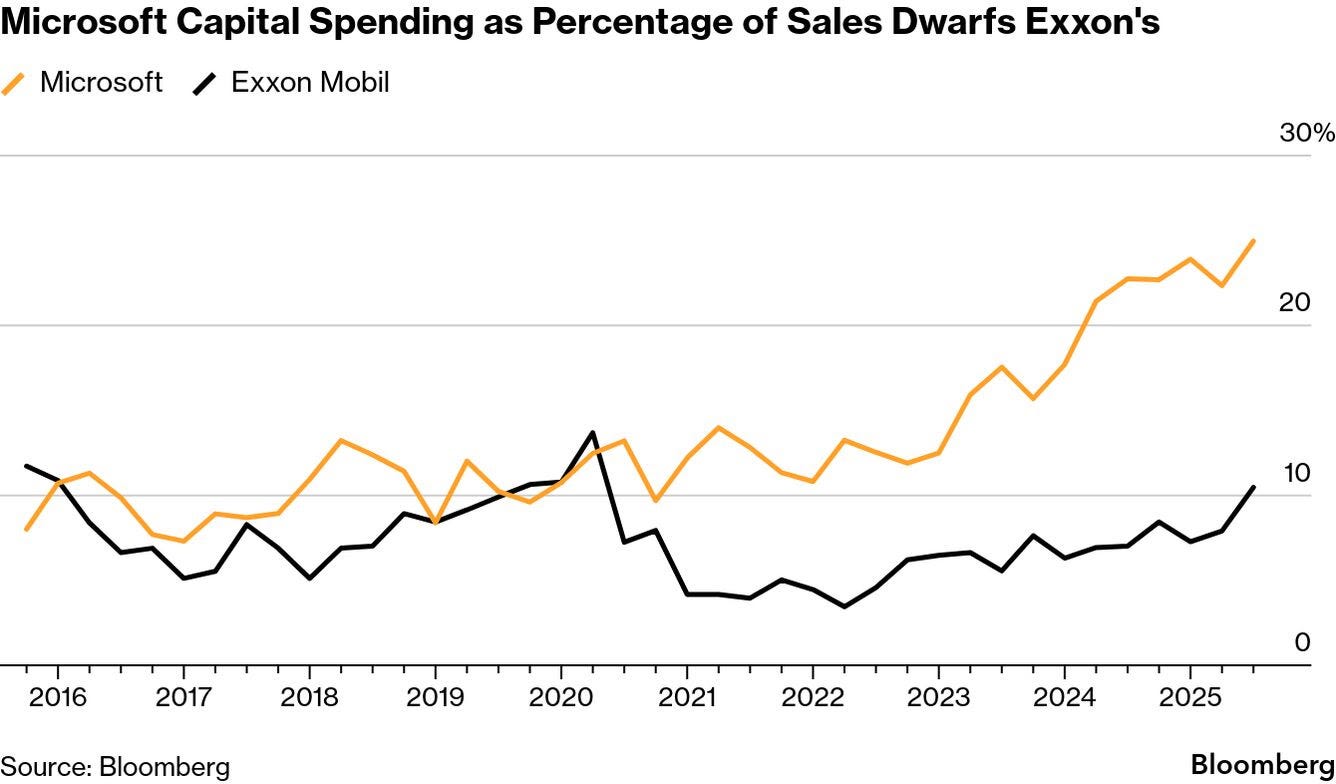
Microsoft is — or at least was! — a software company. And yet today, the company’s capital spending as a percentage of sales is more than double that of ExxonMobil (XOM), traditionally one of the asset-heaviest companies in the world.
Extracting, refining and transporting oil and gas is incredible capital intensive. Think about the massive amount of infrastructure needed for that undertaking.
And yet Microsoft spends more than double what Exxon does in capital spending relative to its sales.
That’s neither “bad” nor “good.”
Some companies require a lot of property, plant and equipment… others don’t.
But here’s the thing.
Software companies trade at premium valuations precisely because they are capital light.
Microsoft trades at a P/E ratio of 34, or exactly double that of Exxon. Does a premium like that still make sense in a world where Microsoft is a more expensive and cumbersome business to operate… and one in which brutal competition from Amazon, Google and others will likely put pressure on margins?
Learning the Wrong Lessons from 1999
I remember the 1990s dot-com bubble.
It was fun!
Right up until it wasn’t.
But what strikes me today is how poorly most investors remember that period. We remember the absurd excesses… profitless companies with no viable business model priced based on “eyeballs” rather that profits… and that obnoxious Pets.com sock puppet that made it to the Super Bowl.

But what they forget is the massively inflated prices of legitimate and highly profitable businesses.
Intel (INTC) may be a joke today, but it was the Nvidia (NVDA) of the 1990s and 2000s. It supplied the critical hardware that made the PC and internet revolution possible.
It was a fantastic company that regularly generated returns on equity in the 30% to 40% range.
It didn’t matter. When demand couldn’t keep up with the unrealistic expectations built into stock prices, the stock cratered by more than 80% and, 25 years later, is still below its old dot-com-era highs.
So when you hear a glassy-eyed tech pollyanna saying that it’s different this time because AI stocks are actually profitable…
It’s not different this time.
Code Red for ChatGPT
I can’t tell you what will be the eventually straw that breaks the camel’s back and causes the bubble to implode. It could be any of an infinite number of things.
