


The AI productivity boom is real. I use AI virtually every day to help me research and perform basic tasks.
And I know we’re just at the tip of the iceberg. We have yet to see the benefits of self-driving cars, AI agents or robotic assistants at anything resembling scale. That’s still coming… and coming quickly.
But will it lead to meaningful and sustainable GDP growth? And will that growth allow us to grow out of the debt crisis we find ourselves in?
On these questions, I’m far less sure.
AI can replace a worker. Or more accurately, it can allow us to produce more “stuff” with fewer people. But it can’t replace a shopper. And in an economy dominated by consumer spending, that’s a distinction that matters.
And whatever growth it generates, it’s hard to see a reality in which we can simply grow out of the debt that Uncle Sam racked up over the past 40 years.
Raoul Pal, one of the most respected macro thinkers alive today, wrote an excellent piece covering this (see What if 1929 Was Our 2008?)
Let’s take a look at what Pal had to say… and see how it stacks up against the wall of debt.
Here’s how he breaks it down:
The Magic Formula
Every economy on earth grows in exactly one way.
GDP Growth = Population Growth + Productivity Growth + Debt Growth
A country gets richer when it adds workers, when those workers produce more per hour, or when it borrows to fund growth it hasn’t earned yet. Every economic story you have ever heard is some mix of those three things. I call it the Magic Formula because it explains almost everything.
For nearly all of modern history the first two did the work. Populations grew, technology made each worker more productive, and economies compounded on both. Debt was there, but it was the supporting act.
That’s no longer the world we live in. Across the West, the first two engines have been losing power for forty years, and to see why, you only have to look at what happened to the population.
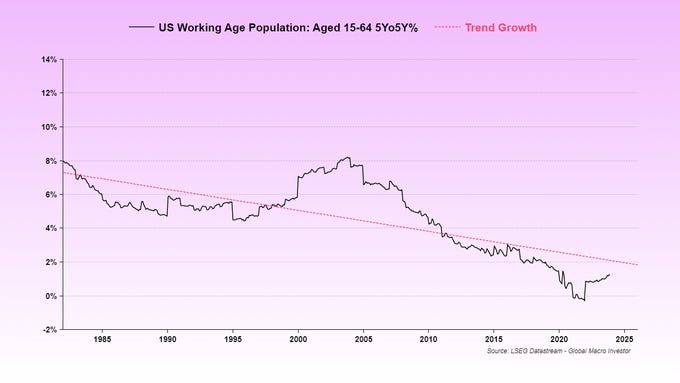
If a population is young and growing, you get more workers every year. That means more people buying houses and cars and filling them with stuff, more taxpayers, and the whole thing compounds on its own. If your population is ageing and flat, you get fewer workers carrying more retirees, and productivity follows, because an economy with fewer working-age people and more retirees produces less per head. So when the demographics turn, two of the three engines cut out at once.
That’s what happened to the West. The underlying growth rate of the US economy has fallen from about 5% to under 2%, and it fell for exactly this reason. Which leaves debt doing almost all of the work.
When you borrow to fund growth you haven’t earned, the interest still has to be paid. If the economy isn’t growing fast enough to pay it, there’s only one place left to get the money. You print it.
That’s what every major central bank has done since 2008. New money appears, the debt gets serviced, the system carries on... and the currency everyone is holding is worth a bit less than it was. The more you owe, the more you print, and the faster the money debases…
So the Magic Formula tells you where the debt came from and why the printing never stops. Demographics set the whole thing in motion. Once you’ve got that, the 1940s and 1950s read like a manual.
We know what happened following the 1929 market crash. The U.S. sunk into the Great Depression and didn’t pull out of it until World War II.
The war blew out the government’s finances. By the time Germany and Japan surrendered, federal debt held by the public had ballooned to 106% of GDP.
But then, Pal’s Magic Formula went to work. Ten million soldiers came home, went to work in the private sector and started families. As Pal puts it, “Between 1946 and 1964, 76 million Americans were born in the post-war boom, and through the 1950s the US population grew at about 1.7% a year. At the same time productivity was rising as all that wartime technology got put to civilian use. Put the two together and the economy grew at around 5% a year, while the debt was growing at the 2.5% the Fed had pinned it at.”
We never really paid the wartime debt back. But the economy grew so fast in the 1950s and 1960s, the debt load dropped from 106% of GDP to just 23% by the early 1970s.
Great!
So, if all it took was monster growth rates driven by demographics and technology, couldn’t we see a repeat of that today?
No serious person believes Uncle Sam will ever pay back the $40 trillion he owes. But if we could grow the economy faster than the debt can snowball, we can muddle through.
Right?
Well, Pal thinks so:
This is where The Exponential Age comes in. AI agents, robotics and cheap energy, each on the same steep adoption curve the internet ran, all arriving at the same time. I wrote in that January 2024 letter that robots and AI are demographics, and I meant it literally. A robot working a shift is a worker. An agent doing the work of a team is a team. They add to the productive capacity of the economy exactly the way the Boomers did, except nobody has to be born, raised and put through school first.
That’s what makes this cycle different from the 1950s, and it’s why I’m a lot more optimistic than the debt numbers would suggest. The 1950s had to wait for children to grow up. That’s the best part of twenty years of holding the debt still and hoping nothing broke. We just need to deploy the machines, and these particular machines deploy on an exponential curve.
There’s just one fatal flaw to this argument.
In order for us to grow out of the debt, debt has to grow more slowly than nominal GDP. That’s not happening. We’re adding about 6% of GDP every year via the $2 trillion budget deficit. We haven’t enjoyed sustained GDP growth at anything close to that in 40 years.
The last time we grew ourselves out of a debt problem, we cut government spending and balanced the budget.
In 1945, the last year of World War II, the federal government spent $92.7 billion. The following year, that number was down to $55.2 billion. And by 1948, it had dropped all the way to $29.8 billion, meaning that the federal budget had been chopped by more than two thirds from its wartime highs.
By 1947, the U.S. government was running budget surpluses most years.
Cutting government spending was easy when World War II ended. We no longer had an existential conflict to fund. That’s a lot harder to do today because most federal expenditures go to non-discretionary items like interest on the existing debt and transfer payments like Social Security and Medicare.
Literally cutting the military budget to zero — mothballing the entire force — wouldn’t balance the budget. It wouldn’t even reduce the budget deficit by half.
None of this minimizes the impact that AI will have on the economy. But “growing out of the debt” isn’t going to happen. That’s just not realistic.
That leaves inflation as the only real “solution” to the debt problem.
And that means you’ll want to keep inflation hedges like gold, income producing real estate and commodities in your portfolio alongside your traditional assets like stocks.